

As an advocate of individual action and focus it is important to me that women re-frame their leadership challenge based on their capabilities and not on the perceived wisdom of generations of male leaders. We are entering a new age of Industry and women’s capabilities are well suited to this emerging environment as long as they forgo conventional wisdom and define their own paths and ways of working. What follows is a ‘manifesto’ for empowering women into leadership roles, repositioning the perceived challenges that women face and converting them into the opportunities to use their strengths and capabilities.
The recent research ‘The 2025 Women in the Workplace Report (McKinsey & LeanIn.Org)’ highlights a concerning decline in women's ambition within the workplace, resulting in the widest gender gap in promotion aspirations ever recorded. The Report records a significant drop in women's interest in progressing – particularly at entry level of leadership - compared to men. The findings recognise that managerial support is vital for women’s advancement, yet the key area of sponsorship and mentoring for senior Leadership roles often favour men, leaving women at a disadvantage.
With organisations reducing their backing for women's career growth, professional women and their employers now face a pivotal moment. Despite ongoing work to encourage diversity and inclusion, there is an increasing trend of cuts affecting relevant initiatives and resources. While the Report encourages organisations to renew their efforts on Diversity and Career support which are important, there are some structural issues which make this increasingly tough to achieve.
The advancement of women through organisational ranks follows a pattern of momentum decay, where early progress is evident but momentum wanes as a goal starts to be reached. Several mechanisms contribute to this momentum decay in women’s leadership development support. Human Resource teams, increasingly tasked with broader responsibilities, often shift from active sponsorship of gender equity initiatives to mere compliance, diluting their impact. Also, organisations come to perceive gender equality as largely achieved and the sense of urgency dissipates, leading to stagnation in progress – well before genuine parity is reached.
“Also, organisations come to perceive gender equality as largely achieved and the sense of urgency dissipates, leading to stagnation in progress – well before genuine parity is reached.”
Additionally Business and Organisational Leadership is becoming less responsive to equality pressures unless there are clear business incentives or risks, with moral appeals losing their effectiveness. The proliferation of competing lobbying agendas further fragments attention and resources, with gender-specific efforts losing their distinctiveness amid wider social initiatives. Additionally, with a reduced fear of reputational consequences from stakeholders, there is less accountability and enforcement, making progress increasingly optional rather than necessary. Collectively, these factors start to explain why the progression curve for women’s advancement flattens, especially at senior and executive levels. Progress slows and eventually plateaus, highlighting the need for renewed and targeted efforts to sustain momentum and achieve lasting change.
These counter pressures are particularly impactful for advancement of women at the senior levels of leadership, as women attempt to move from manager to senior manager, the key elements of positive sponsorship and advocacy become less available to women with fewer women supported to advance further. By contrast, once we reach Board level, women’s representation becomes more stable due to clear targeted goals, reputational governance requirement, and clear monitoring. However, the pipeline of women ready to step into these roles continues to thin, with these underlying issues of senior level advancement remaining unresolved.
What can we do? in a landscape marked by reduced sponsorship, weakening organisational support, skewed perceptions of Hybrid working and the disruptive impact of AI, women can accelerate their leadership progression by adopting a practical, behaviour-led strategy rooted in their existing strengths. By focusing on autonomy, their clarity about what needs to be done, and viewing difficult tasks as goal challenges to master and overcome, women reframe their advancement as proactive leverage rather than passively waiting for systemic change.
The question for women becomes do we sit back and hope the general advocacy for women’s leadership support filters through and wins out with other competing organisational pressures or do we re-frame and focus our approach and take direct action for ourselves. Over decades of Executive Coaching, where it has been a privilege to coach some of the most talented women in the land, moving the mindset from the organisation ‘suggesting-dictating’ what the women should do, to a much more empowered position of women deciding what they want, releases energy, and decisive actions to progress their ambitions and vision of their future.
Ultimately, women are fully capable of overcoming these obstacles, not by working harder, being louder, or absorbing additional strain, but by aligning their work with their inherent strengths, opting for leverage rather than effort, creating their own visibility, transforming complexity into clarity, and allowing flow to replace force. This approach is not about enduring adversity or mere survival; instead, it represents leadership achieved through coherence and authenticity. Women can achieve this by systematically reframing their reality and leveraging their strengths.
“This approach leverages natural female strengths in risk calibration and enables controlled exposure rather than reckless confidence.”
Building Coalition of Power, Not Dependency, as senior male sponsorship becomes less visible, women should shift from seeking individual patrons, to their strength of forming strong, trust-based alliances across different functions. By cultivating 3 – 5 peer-adjacent relationships and positioning themselves as connectors of outcomes, women leverage their natural influencing skills to become more resilient and less risky for any one sponsor to support.
Treat Career Risk as a Portfolio, rather than viewing career and job risk in binary terms (“safe” or “not safe”), women can adopt an investor’s mindset by balancing their efforts: 60% on their core credibility and proven reliability, 25% on adjacent stretch roles on future ready skills building promotion readiness, and 15% on high-upside opportunities with visibility, innovation and leadership stretch. This approach leverages natural female strengths in risk calibration and enables controlled exposure rather than reckless confidence.
Reframe Setbacks through External Perspective, when encountering obstacles or rejection, women can practise reframing - distinguishing between structural and personal constraints, extracting learning, a major female strength, and adjusting their approach for future opportunities. This mirrors the resilience strategies of elite performers, focusing on rapid recovery and strategic adaptation rather than internalising setbacks. It’s a calm, practical way to keep moving forward - and it’s a strength many women already have once they use it deliberately.
Prioritise Security and Visibility Over Perceived Safety, in the era of AI, roles considered “safe” are often the most automatable. True security comes from being highly visible in areas central to the organisation’s priorities – such as AI, Regulation, and Transformation. Women’s strengths in problem framing, stakeholder management, and long-term thinking are key, as these are non-automatable leadership qualities.
Lead in AI Through Judgement, Not Coding, women do not need deep technical expertise to lead in the AI space. Instead, they can excel as “AI translators” – asking the right questions, governing risk and ethics, and integrating AI into strategic decisions. Core female assets include contextual intelligence, speed, and commitment to learning, ethical foresight and understanding human-system integration.
Use Strategic Language to Advance, given that direct self-promotion can trigger backlash, women can reframe their advancement as a fit for critical business needs, rather than as personal ambition. This focuses on the role requirements such integration skills managing risk and effective delivery for the organisation.
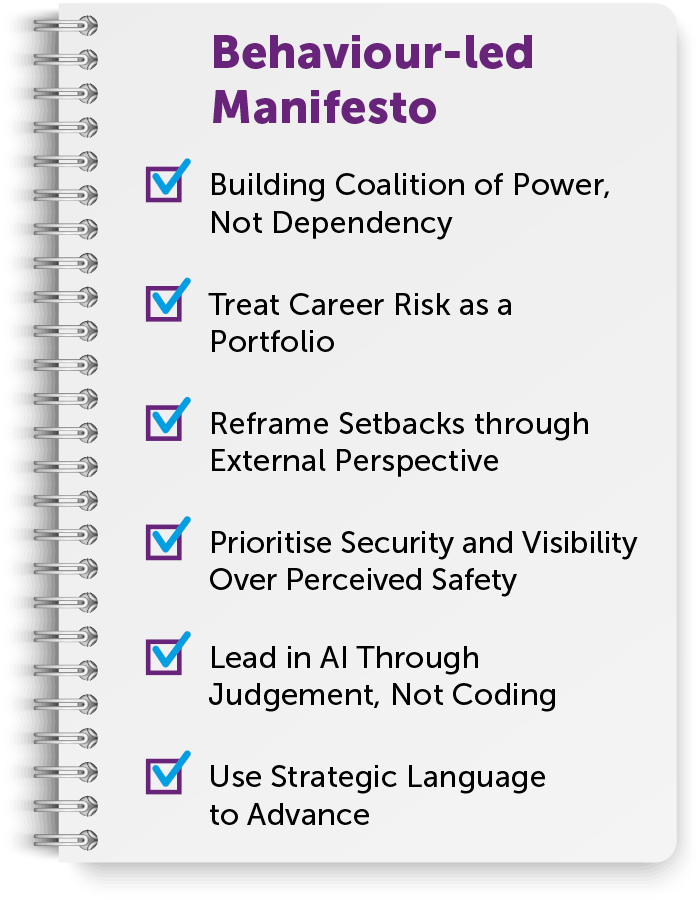
This ‘Manifesto’ calls on women to advance without waiting for traditional sponsorship or adopting male-coded risk styles, instead using relational strengths to build coalitions, and treating career risk as a balanced portfolio. It reframes resilience as rapid learning, positions AI leadership as judgement and governance rather than technical expertise and presents career progression as solving organisational problems rather than expressing personal ambition. By focusing on these behavioural strategies, women can navigate and thrive within the realities of modern, evolving organisations.
Another challenge to women’s leadership advancement is the ability to lead in Hybrid and Remote Work Environments. This is one of the less visible career jeopardies for women. The evolving landscape of work has seen a distinctive preference among women – particularly those in senior positions – for hybrid or remote working arrangements. This inclination is not simply a matter of comfort but is instead rooted in the ability to better manage cognitive load, maintain boundaries, work more efficiently, and avoid non-essential visibility rituals that do not contribute to meaningful outcomes.
However, despite evidence that women working remotely perform as well as, or even better than, their office-based counterparts in terms of output, the real challenges they face are not performance but issues of perception, power dynamics, and informal access to opportunities. Leadership in many organisations is still closely linked to physical presence, which is often equated with commitment, visibility with readiness, and informal access with trust. As a result, remote senior women risk being unfairly perceived as less engaged or politically astute, even when this is not the case. At senior levels, promotions are less about formal KPIs and more about confidence signals, narrative control, and sponsorship. Therefore, remote women leaders need to be proactive in managing how their contributions are perceived and in ensuring their value is visible to key stakeholders.
They need to reframe their remote work as a strategic operating model that maximises decision-making speed, stakeholder access, and delivery impact, rather than simply a matter of flexibility. By adopting deliberate visibility strategies such as sharing pre-read memos, summarising outcomes, and visibly owning cross-organisational results they broadcast impact rather than relying on passive presence. By aligning their work with critical business agendas, tied to non-negotiable organisational priorities such as AI transformation, regulatory compliance, enterprise change, and talent strategy, they demonstrate focus and leadership. At the same time, they need to maintain a selective but strategic physical presence at key decision points, stakeholder resets, and moments of ambiguity, treating in-person attendance as a targeted intervention rather than a routine habit.
The real risk for Hybrid working remote senior women is not the act of working from home itself but rather allowing others to fill the narrative vacuum with their own assumptions, which can lead to a gradual erosion of credibility. To counter this, women must actively own and communicate the story of their value and contributions. This depends on their ability to manage perceptions, design visibility, anchor their work to strategic priorities, and claim leadership in emerging domains such as AI. Those who do so can ensure that hybrid work is not a career liability but a potential accelerator for their leadership journey.
While all this sounds very exhausting, reframing the challenges women face is about shifting the perspective from exerting more effort to achieving better alignment. Rather than pushing harder, women can succeed by tapping into strengths they already possess and entering a state of flow. What often feels exhausting – such as constant visibility, adversarial risk-taking, reliance on single sponsors, and performative confidence – is actually the result of trying to progress with models not designed for women. By advancing through their natural behavioural advantages, effort decreases while effectiveness increases, embodying the concept of flow.