

A Board perspective on governance, judgement and performance in an era of disruption.
Text from a recent discussion I led for The Pipeline
For many years, Corporate Governance was treated as a largely procedural discipline: necessary, important and seldom regarded as a source of Strategic advantage.
That assumption no longer holds. From the vantage point of the Boardroom and the Executive office, it is clear that Governance has moved well beyond its traditional role. In an environment defined by geopolitical volatility, economic fragmentation, technological acceleration, social scrutiny, cyber exposure and AI disruption, Governance is no longer a supporting function. It is becoming a Core Discipline of Board Leadership.
The Businesses and Organisations most likely to compete and perform over the coming decade will not be those with the most extensive policy frameworks or the largest compliance functions. They will be Boards and Executive teams who understand the emerging reality, that Governance is not about constraining Leadership. It is about enabling Leadership to act with pace, discipline and coherence when the environment is unsettled and the stakes are high.
Boards and Leaders are operating in one of the most compressed and complex periods of change in recent memory. Markets reprice rapidly, Stakeholder expectations move continuously, Reputational issues can escalate within hours, and Technologies such as AI are shortening decision cycles faster than many Institutions can comfortably absorb.
Within that context, Governance becomes one of the principal means by which a Business and Organisation preserve alignment, resilience and Strategic clarity while still moving decisively.
Governance is expanding far beyond compliance
The scope of Governance has widened dramatically. Boards are now expected to oversee not only Financial Performance and Risk Control, but also the Organisational Culture, Workforce Strategy, ESG priorities, AI Governance, Cyber Resilience, Geopolitical Exposure, Succession, Data Ethics, Stakeholder Trust and Reputational Integrity.
That expansion materially changes what Board Leadership demands. Technical Expertise remains necessary, but it is no longer sufficient. Board Leaders increasingly require systemic thinking, judgement under uncertainty, strong communication and the ability to connect issues that were once managed in isolation.
A cyber incident can rapidly become a reputational issue, a workforce culture problem can escalate into a Governance matter, and an AI deployment decision can trigger Regulatory, Ethical and Investor Scrutiny all at the same time and often in competing directions.
Governance therefore becomes less a matter of isolated controls and more a matter of Institutional Coherence. A conventional compliance mindset is no longer sufficient for an operating environment defined by continuous change and interconnected risk.
Governance in a chaotic world
Many traditional Governance Models were designed for a more stable period, when change was slower, risks were easier to isolate and Business and Organisational Boundaries were clearer. That model is now under sustained pressure.
Today’s environment is marked by overlapping disruptions, from geopolitical fragmentation and trade realignment to supply chain volatility, AI acceleration and information overload. At the same time, social media amplification, polarised public discourse, climate transition pressures, workforce transformation and cyber insecurity are reshaping the context in which Boards and management teams must act.
In many Sectors, Leaders are no longer managing discrete risks. They are navigating interconnected systems of uncertainty, in these conditions, good Governance is no longer defined solely by tick box oversight. It is increasingly defined by adaptive capacity.
The most effective Governance Structures help Businesses and Organisations absorb volatility, accelerate decision-making, sustain institutional trust, improve organisational learning and preserve strategic direction through disruption.
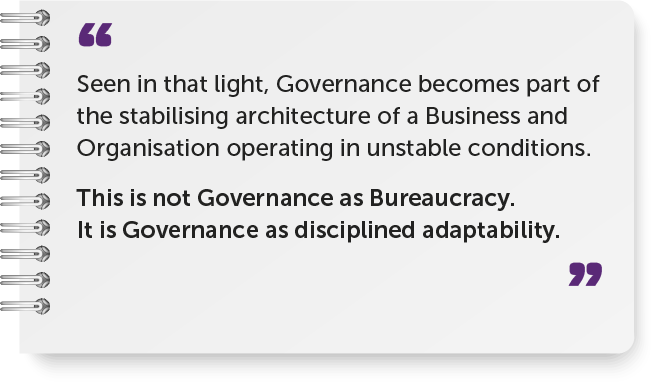
Seen in that light, Governance becomes part of the stabilising architecture of a Business and Organisation operating in unstable conditions.
This is not Governance as Bureaucracy. It is Governance as disciplined adaptability.
AI is reshaping governance faster than many businesses and organisations realise
Artificial Intelligence may prove to be as consequential as electrification, the internet or mobile communications, but it is arriving with a speed and breadth that few Businesses and Organisations have previously encountered.
Unlike previous technological shifts, AI is simultaneously reshaping decision-making, operations, workforce structures, customer engagement and risk exposure.
The Governance challenge is therefore substantial. AI can accelerate productivity and strategic insight, but it also introduces bias risks, accountability questions, cybersecurity vulnerabilities, regulatory uncertainty, workforce disruption, ethical concerns and reputational exposure.
Many Businesses and Organisations still frame AI primarily as a technology agenda. From a Board and Chief Executive perspective, it is plainly a Governance agenda as well.
Boards require AI literacy not because Directors must become technologists, but because AI-related decisions now shape accountability, trust and long-term resilience in ways that fall squarely within Governance oversight.
The question is no longer simply how to adopt AI, but how to govern it in ways that strengthen trust, judgement and organisational capability.
The Businesses and Organisations most likely to benefit will be those that establish AI Governance early, embedding clear oversight, accountability, transparency and human judgement into deployment models before external pressure forces the issue.
Collaboration is becoming a governance capability
Another important shift is the growing role of collaboration as a Governance capability. Risk, Finance, Technology, Operations, Workforce Strategy, Communications and Reputation Management are now deeply interdependent, and Governance is stronger when the Board and Leadership team can work across disciplines and align different parts of the enterprise around shared priorities.
That places a premium on the quality of discussion within the Boards and Executive teams.
The strongest Governance Cultures are rarely the most procedural. They are the ones in which difficult conversations happen early, information moves freely, challenge remains constructive, expertise is shared and Strategic decisions are understood across the Leadership group.
In that setting, Governance is less a barrier and more a mechanism for coordination across a complex enterprise.
Succession planning as a strategic imperative in a shifting landscape
This shifting Governance landscape has significant implications for the Succession Planning of the Business and Organisation. Previous Leadership Models often placed greatest value on operational control, sector expertise and execution efficiency.
Future Leadership will require more: adaptability, strategic judgement, systems thinking, digital and AI fluency, geopolitical awareness, stakeholder management and resilience under sustained uncertainty.
Consequently, succession planning takes on greater Strategic weight, as many Businesses and organisations reassess whether traditional Leadership pipelines remain fit for the environment ahead.
This matters all the more because these Businesses and Organisations are now navigating generational and technological transition at the same time.
The task is no longer simply to identify who can run the Organisation as it stands today. It is to identify who can Lead it through conditions that are still emerging.
Succession planning therefore becomes not only an HR process, but a central Governance responsibility.
Governance as a competitive advantage
The most important shift, in my view, is to recognise Governance as a source of Strategic Advantage, not merely a mechanism for risk mitigation.
Businesses and Organisations with mature Governance capability are typically better positioned to adapt quickly, integrate new technologies responsibly, maintain Stakeholder confidence, navigate crisis, attract investment, retain talent and sustain long-term performance.
In volatile environments, trust becomes an economic asset, and Governance remains one of the principal means by which that trust is earned, reinforced and protected.
That is why Governance now belongs at the centre of a Board Strategy, not at its edges.
The more important question is whether our Governance Frameworks are evolving fast enough to support Leadership that is decisive, well-judged and resilient under pressure.
In the years ahead, Governance will do much to determine which Businesses and Organisations lose momentum, which preserve it and which convert it into enduring Leadership.